... “It’s part methodology, part philosophy,” says Maggie Hyde, co-owner of Wisconsin’s Petal Back Farm, which incorporates biodynamic practices in growing its floral crops. “The biodynamic garden should be thought of as an organism. The idea is to create a diverse ecosystem, which creates resilience, and to give back more to the ecosystem than you take out.”
Proponents of the practice also highlight the benefits for the gardener. “The nutrient density of the food is increased, the flavors are typically enhanced and the shelf life of the crops will be longer,” says Joseph Brinkley, director of regenerative farming at the Bonterra Organic Estates vineyard in Hopland, Calif., which incorporates biodynamic practices....
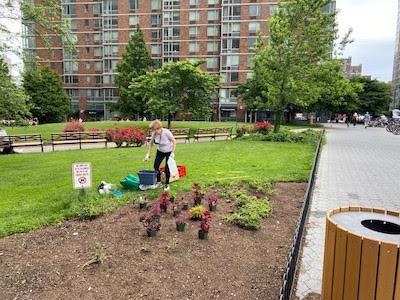
yesterday during the April 22 Roosevelt Island Earth Love Day. According to Ms Ferguson:
We're very happy to have worked with Matt Kibby, our Horticultural
director on Roosevelt Island. We were able to order a lot of perennials shrubs and flowers...
... We've been hoping to work on this area for some time and this is a great opportunity.... it's been a really fun day...
Will have more from Roosevelt Island Earth Love Day tomorrow later this week.
M. A. Witt is one of the volunteers contributing a great deal of time, effort and resources to make Roosevelt Island bloom by tending to the flowers and trees in the Southtown Riverwalk area. These efforts are enjoyed and appreciated by most residents but unfortunately there are exceptions. Ms Witt reports:
An Open Letter to the Person Who Tore Up Our Garden
On Monday September 26, I arrived back to the Island to find that someone had come in the middle of the night, prepared with a large bag and a garden spade, to steal one of the mature growth very large ferns from our building tree pits in front of 455 Main Street. This individual was caught on film.
There is no doubt from the footage, and the late hour, that she knew she was stealing. My question is what motivates someone to come in the dark and steal from/vandalize a garden that is planted for the enjoyment of an entire community. What kind of un-reflected selfishness makes someone think that is okay?
A little background. When I am out working in the garden, the overwhelming majority of people who stop are kind and always express their appreciation for volunteers who give their time to make the Island beautiful. They share their thoughts and experience and chat for a brief moment: gardening is an activity that brings people together, that forges community. One gentleman, however, stopped to tell me that "big corporations plant the tree pits." I need to make clear that big corporations have nothing to do with the gardening on this island, at least not at our building. A small group of very hardy volunteers goes out in all kinds of weather weekly to tend these beds. They do it because they love gardening, to bird watch or from a sense of service to the community. What they are not is big corporations. They are not deep pockets. In short, this was not a victimless theft from a faceless entity. Individual people were harmed when this garden was vandalized. People I know and care about.
More importantly, these volunteers garden to conserve resources and to preserve the environment -- both social and ecological. This island could not afford the plantings we enjoy without the labor of volunteers. RIOC does not plant or tend flowers in the Commons by the Subway. The few that are planted there are courtesy of the tireless generosity of one woman.
Ironically, the fern that was taken is seasonal. It will die indoors in someone's apartment. The lasting impact of this will be limited to the sadness it caused to the volunteers who care for these plants, and in diminished expectations.
Roosevelt Island Garden Club
(RIGC) member Julia Ferguson reports on a new community planting project taking place at
the Cherry Tree Grove on the East River waterfront promenade across from the Rivewalk
Commons.
According to Ms Ferguson:
RIGC has been working on a collaborative community outreach program. The focus
of the outreach series is Roosevelt Island as an Ecosystem in which soil,
climate, water, and plants, trees and landscape interact with humans, animals,
insects, birds to sustain life on our little urban island.
Learning about how ecosystems work with specific
examples, and planting native plants to provide habitats for beneficial
insects and
Bring beauty to the island, and increase biodiversity....
I spoke with RIGC members Julia Ferguson and Jack Burkhalter earlier this summer as they were working on the Cherry Tree Grove planting to learn more about the project and their future Roosevelt Island Ecosystem collaborative plans.
Contact rigardenclub@gmail.com
if you are interested in volunteering for the fall planting at this
site.
Roosevelt Island Garden Club
(RIGC) member Julia Ferguson reports on a new community planting project taking place at
the Cherry Tree Grove on the East River waterfront promenade across from the Rivewalk
Commons.
According to Ms Ferguson:
RIGC has been working on a collaborative community outreach program. The focus
of the outreach series is Roosevelt Island as an Ecosystem in which soil,
climate, water, and plants, trees and landscape interact with humans, animals,
insects, birds to sustain life on our little urban island.
Learning about how ecosystems work with specific
examples, and planting native plants to provide habitats for beneficial
insects and
Bring beauty to the island, and increase biodiversity.
Roosevelt Island resident and RIGC member Jack Burkhalter, an urban
naturalist, worked closely with RIOC's Matt Kibby’s oversight to design and
plan out the details of the planting.
RIOC provided over 1000 native habitat
bare roots and plant plugs for ground cover plants. Cornell Tech Students and
RIOC staff prepped the site. And on April 30, 2022 for #EarthLove Day, over 60
people, including lots of children, visited the educational table in the park
west of Meditation Steps and learned about how violets, milkweed, and sumac
trees nurture pollinators and ants, and how these insects benefit these
plants. An equal number of Roosevelt Islanders of all ages and abilities
joined to help plant over half of the planting area under the four old Yoshino
Cherry trees. On that day, a white throated sparrow was singing his joy, and
we may have heard the cherry trees thank us as we brought them new companion
plants and tickled/aerated their roots.
Lady Ferns, Foam Flowers, Violets, Wild Geraniums, Penstemon, and Pennsylvania
Sedges: all of these ground covers will be pleasing to see and they will also
welcome butterfly larvae, native pollinators, and help support bird life
especially in the spring. Phase 2 plans are for Wild Ginger, more Penstemon,
White Wood Asters, and a low growing soft Goldenrod to provide fall nectar for
pollinators and continued colors in autumn.
I spoke with Ms Ferguson and Mr Burkhalter earlier this month as they were
working on the Cherry Tree Grove planting to learn more about the project and
their future Roosevelt Island Ecosystem collaborative plans.
Ms Ferguson adds:
On April 7, 2022, Rebecca McMackin, Director of Horticulture at Brooklyn
Bridge Park (BBP) spoke with Roosevelt Islanders in a free virtual talk. Ms.
McMackin knows about the challenges and rewards of turning an urban landscape
(Brooklyn piers and industrial area) into a thriving, stunningly beautiful and
healthy ecosystem. We appreciated Rebecca’s inspiration and willingness to
share her learning: the principles, and the practices of her entire BBP
Horticulture Staff where the “dynamic relationships” of both people and
ecosystems are honored and where the lives of plants, caterpillars,
butterflies, birds, and people fit together “seamlessly” in an urban setting.
Over 80 people from all five boroughs of NYC, from places across the U.S., and
from Nova Scotia to New Zealand were able to join us for Rebecca McMackin's
talk.
Click here to read
through some of the key takeaways and watch the April 7, 2022 recording of
Rebecca McMackin from Brooklyn Bridge Park: A case study for seeing Roosevelt
Island as an ecosystem.
These days, more people are looking closely at building and grounds
sustainability as well as landscape ecology practices when they make decisions
on where to live and work. Together as an Island community, we can continue to
create a model for ecological health and beauty through collaborative
projects. With Roosevelt Islanders help we have completely planted Phase One
for this little habitat site. It takes a village and we are especially lucky
in that regard. Gratitude for another RI habitat planting providing health and
beauty after EarthLove Day 2022!
Stay tuned for other opportunities to learn and engage with this idea and more
from “Roosevelt Island is an urban ecosystem.” Write to rigardenclub@gmail.com
if you are interested in possibly volunteering for the fall planting at this
site.
Thank you so much to RIOC, the RI community, and RIGC members for all the
help. With Roosevelt Islanders’ help we have now planted another lovely
little habitat site. This established landscape bed will glow in a year or two
as the plants fill in.
Any ideas for the next collaborative Roosevelt Island urban ecosystem gardening project?
Celebrate the Life of Bonnie Ora Sherk Wednesday, May 18th, 5:30 PM at
Roosevelt Island’s A Living Library Think Park & Garden (in the rear of
the garden)
Last November,
Roosevelt Island resident Matt Katz reported the sad new of Ms Sherk's death.
According to Mr Katz:
Our friend and long-time colleague involved with the beautification of
Roosevelt Island, Bonnie Ora Sherk,
passed away in August at her home in San Francisco. While not a Roosevelt
Island resident, Bonnie had a second home in Manhattan and came to us over
twenty years ago on a $50,000 Ford Foundation grant.
Bonnie was a landscape architect with credentials in San Francisco and
around the world. Her early focus here was Southpoint Park which was slated
for major renovations, and Bonnie's schematics for that task were printed in
The Main Street WIRE March 20, 2004
issue at the time. They included plans for a boathouse and launching site
for kayaks regrettably never built. The Trust for Public Land conducted its
own planning at the time, which would have included a make-over of the
Renwick Smallpox Hospital Ruin. RIOC rejected these innovative ideas and
produced our current, modest Southpoint Park.
Bonnie was the founder and director of Life Frames, Inc. the sponsor of
A Living Library (ALL)
whose mission was, "to transform derelict environments with systemically
integrated hands-on learning for all ages resulting in ecological,
place-based branch Living Library & Think Parks in diverse parts of the
world." Her work has been displayed at the P.S. 1 gallery in Queens as well
as at the
Biennale in Milan, Italy.
Bonnie never received the municipal financial support in New York City that
supported her projects in San Francisco, but took advantage of the RIOC Public
Purpose Fund to continue creating projects, built with the sweat equity from
all sectors of our population. She turned her attention to the
PS/IS 217 schoolyard
where both children and adults labored to haul the soil and manure necessary
to transform the area under the hallway windows into a vegetable and flower
garden.
She planted an orchard of fruit trees on the west promenade school property,
tragically destroyed during major school renovations. There are still two
pin oaks, planted by the school kids, across Main Street from the school
entrance.
Currently, A Living Library is represented by the garden
located between our new library building and Blackwell Park, now under
renovation. The park, under the leadership of
ALL Director China Bushell,
is maintained with the support of many residents, old and young, and you may
have joined the Trick or Treaters at that wonderfully (gruesomely?)
decorated crypt over Halloween.
Those of us who worked with Bonnie over the years miss her terribly. We know
how much she loved Roosevelt Island and Roosevelt Islanders. A memorial is
tentatively planned for next May, Bonnie's birthday with a plaque to be
placed on one of the garden's benches and a tree planted in her name. What
could be more appropriate?
Here's a 2014 interview with Bonnie Ora Sherk describing her
A Living Library
life long project.
20 years ago they teamed up to see if there were enough floral resources in
the Bronx for the Monarch butterfly and found out there wasn't. Their answer
involved creating the Butterfly Project NYC. Together with neighbors they
built out Monarch butterfly corridors by planting to attract pollinators and
to date they have given away over 75,000 free native plants to the
community.
iDig2Learn is thrilled to celebrate our 10th anniversary with this special
free webinar Thursday, March 31st at noon. RSVP a must, space is limited -
email "Pollinators" to
idig2learn@gmail.com to secure your
spot and get the Zoom link. Don't miss this one.
Ursula Chanse is the Director of Bronx Green-Up
and Community Horticulture at The New York Botanical Garden. Since 2005, she
has managed Bronx Green-Up, the community gardening outreach program of The
New York Botanical Garden. This program provides horticulture education,
training, and technical assistance to Bronx residents, community gardeners,
urban farmers, local schools, and community organizations. Ursula’s background
includes ecological horticulture, public health, community education,
organizing and advocacy work.
Chrissy Word is Director of Education at City Parks Foundation and oversees
the development of dynamic STEM programs for youth in the most underserved
neighborhoods of NYC: Green Girls, Coastal Classroom, Learning Gardens, Seeds
to Trees and Career/College Readiness for high school interns. Chrissy has 20
years of experience and training in student centered pedagogy, child
development and experiential learning. She has developed and implemented a
number of successful citizen science projects for high school youth on the
Bronx River and as co-founder of Butterfly Project NYC, a grassroots
conservation organization, she initiated a pollinator curriculum guide for NYC
teachers.
Creating Urban Landscapes: stunningly beautiful gardens can also contain
thriving wildlife habitat in the heart of an urban setting.
A free virtual lecture sponsored by RI Community Garden in partnership with
iDig2Learn, Cornell Tech, and Roosevelt Island Operating Corporation.
Rebecca McMackin is an “ecologically obsessed horticulturist and garden
designer. ”She has spent the last decade as Director of Horticulture of
Brooklyn Bridge Park, where she manages 85 acres of diverse parkland
organically and with an eye towards habitat creation for birds, butterflies,
and soil microorganisms. Rebecca lectures and writes about landscape
management, pollination ecology, and designs amazing gardens.
Urban residents interested in the green spaces around you and professionals
working in parks, landscape, or building management are invited to hear more
about how:
Ecologically managed, beautiful urban spaces provide quiet for nesting
birds, host plants for butterflies, pollen for bees, and life-restoring
moments for humans.
Creating and curating city spaces as ever-changing natural ecosystems aligns
well with art, sports, and daily community life.
Watch this video of Ms McMackin speaking on developing a thriving ecosystem at Brooklyn Bridge Park.
... networks and collaborates to conserve beneficial pollinating insects and
the resources they need to survive. Our members work on a variety of projects
that support pollinator habitat in public and private spaces, provide
educational outreach on pollinator protection, and develop advocacy programs
and policies around pollinator conservation. Our goal is to be a model for
creating pollinator sustainability in urban environments.
Last Friday, the NYC Pollinators visited Roosevelt Island and toured our
Community Garden hosted by local residents Christina Delfico of iDig2Learn and
Julia Ferguson of the Roosevelt Island Garden Club.
... One really important thing that I think our group does is celebrate wild
bees and wild pollinators. Alot of people think about pollinators, they think
about honeybees but there's a lot more to pollinators than honeybees. There's
wild bees, there's butterflies, there's beetles, there's flies, there's wasps
and moths. There's a whole world of pollinators out there and the native
plants that they depend on which are so important.
The group also learned about Roosevelt Island composting efforts at the
Community Garden from Green Roosevelt Island Neighbors (GRIN) Founder Anthony
Longo.
I asked Roosvelt Island resident and
iDig2Learn founder
Christina Delfico;
Have you noticed if the Spotted Lantern butterfly is a problem yet on
Roosevelt Island?
Ms Delfico replied:
Spotting the Invasive Spotted Lanternfly & Why it Matters
As someone who stops to smell the daisies, and notices all the living things
dependent upon the plants around us, I started hearing about the Spotted
Lanternfly from experts in the insect world and urban naturalist community
months ago. The hope was it wouldn’t come to NYC, but having been spotted in
Pennsylvania everyone knew it was on its way.
So much of our work is about protecting public open green spaces and
restoring balance by nurturing plantings to attract pollinators like the
butterflies, wild bumble bees, birds and flower flies that any talk of
killing a living thing is disturbing. Getting the word out is important, as
is educating the public on the invasive, albeit beautiful, Spotted
Lanternfly.
Traditionally, there are checks and balances in nature. Introduced and
invasive species of insects, plants, fish and birds often don’t have
predators to keep their populations from exploding in number. And that is
the case with the invasive Spotted Lanternfly which sucks sap, weakening
trees and leaves a sticky residue prone to sooty mold. The natural predator,
a parasitic wasp, doesn't live here. And even though there is a study
happening right now to see if local and migrating birds will eat it, there
isn’t a lot of time to waste.
So while the life cycle study of the Monarch butterfly may lead to
protecting it, please watch this two-minute video from
Pennsylvania State University
to become familiar with the Spotted Lanternfly in all cycles of its life -
from egg to nymph to adult - and learn what to do.
... Harming our city’s wildlife is prohibited, but in an effort to slow the spread of this troublesome species, we are putting out a one-time call: if you see a spotted lanternfly, please squish and dispose of this invasive pest....
They arrived in PA a few years ago and now they are in all five Burroughs of
NY. I have a friend in NJ who owns a Tree of Heaven, their favorite tree, and
a swarm of Spotted Lanternflies have covered her garden. I have seen a couple
on Governor island last weekend. We have seen them in the Roosevelt Island
garden and elsewhere on the island. I have personally killed 2 so far. (Kill
one this year so you do not need to kill 50 next year.) They are harmless to
humans but deadly to trees and plants. They like to climb trees so they must
have thought I was a tree when it climbed up my leg before I killed it after
several attempts. They hop around when you try to step on them.
In addition to putting up a 'Wanted Dead" poster on our bulletin board about
the Spotted LanternFly we recently sent out this notice to our garden club
membership:
These insects are active late in the day and at night. Bring your rolled
up newspapers, your fly swatters, your boots with heals and crush this
enemy of our trees and plant. We need to move fast because they move like
grasshoppers. This is the time, the month of September is when they lay
their eggs. Look for that brown peanut brittle spread. It could be on the
bark of a tree or on any hard surface, rocks, bricks, metal, wood. Remove
it, destroy it.
They are notorious hitchhikers. Please try not to bring them from any
gardening center in another borough, NJ, or PA. Lets act early and
vigilantly before they can establish their swarming colonies.
Today, I asked the Roosevelt Island Operating Corp (RIOC) what they are doing about the Spotted Lanternfly. No response yet.
:
The Roosevelt Island Garden Club Community Garden is located on Roosevelt Island in New York City between the Octagon soccer field and the Pony baseball field. The south garden entrance is across from the Fire Department at 750 Main St. Roosevelt Island Garden Club, Inc. is a leaseholder of the Roosevelt Island Operating Corporation and subject to the laws of NY City and NY State....
... RIGC members and associates work together as volunteers gardening side by side in this 132 plot community space. Members also work together as volunteers on all administration, maintenance, and upkeep of this beautiful space for our Roosevelt Island community. The gardens are open to the public on weekends from April 15 through October 15.
Today,
Big Reuse
delivered a truckload containing 9 cubic yards of compost from it's facility
in Gowanus Brooklyn to the
Roosevelt Island Living Library
next to the new Public Library branch at 504 Main Street.
Living Library Teacher and Gardener China Bushell explains that the Roosevelt
Island Living Library is built on compost, no soil at all, and with the added
compost, more flowers and vegetables can be planted in the garden.
This was a good day for Ms Bushell and the Roosevelt Island Living Library
unlike May 20 which Ms Bushell described as " one of my worst days on
Roosevelt Island."
On May 25, I asked the Roosevelt Island Operating Corp (RIOC):
I'm told last Saturday, a brutally hot day, the Living Library gardener
attempted to use the Youth Center Water Connection for the plants and to save
trees that were dying as she has done for several years in the past. According
to the Gardener she was stopped from doing so by Erica Spencer-El who claimed
the Gardener was trespassing and filed a complaint with Public Safety.
Is this true? Any comment from RIOC on the matter?
Ms Spencer-El is the RIOC Director of Communications and Community Affairs.
RIOC has not responded to my inquiry.
In response to Living Library Director Bonnie Sherk's
email about this incident, RIOC President Shelton Haynes replied:
... I was made aware of the incident that occurred last week with regard to
the request for water usage near the RIOC Youth Center. Please know it is
always RIOC’s intention to have positive professional exchanges with
Roosevelt Island community members, stakeholders and the public at large. As
an update, we have plans to upgrade the area adjacent to the library which
includes having a permanent water source. We anticipate that this project
should be completed in the fall 2021.
I have copied John O’Reilly, CFO on this correspondence as he will work with
you and your team on a temporary solution for water access. We would also
like to discuss some additional upgrades to the area that your group works
in.
Lastly, Rosanna Ceruzzi inquired if there was an NYPD report filed on the
matter. Our Public Safety leadership confirmed that there was no NYPD
involvement or reports filed. Ms. Bushell, does not have any NYPD record
that will need to be expunged. A member of the RIOC Public Safety
department, who was assigned to the Youth Center that day was on the scene
during the discussion. As part the requirement of the Public Safety
department, he made an incident report in which all parties involved have to
identify themselves....
Roosevelt Island is a mixed income, racially diverse waterfront community situated in the East River of New York City between Manhattan and Queens and is jurisdictionally part of Manhattan. The Roosevelt Island Tramway, which connects Roosevelt Island to the rest of Manhattan, has become the iconic symbol of Roosevelt Island to its residents.
The Purpose of this Blog is to provide accurate and timely information about Roosevelt Island as well as a forum for residents to express opinions and engage in a dialogue to improve our community.
.jpg)




.jpg)


