... develops mobile sensing systems for capturing, learning, and interpreting people's context, activities and social networks. We are building applications that improve people's well-being and quality of life.
The People Aware Computing Lab is seeking volunteers for their Calming Moments Study:
... to understand how well does the subtle vibration on the wrist can help with anxiety in-the-moment.
The study will be one-week long. During the week, participants will wear a heart rate monitor throughout the day. The anxiety intervention will be delivered at random times throughout the day. After the intervention and at the end of each day, participants will fill in a short questionnaire....
Do you experience anxiety? The researchers at Cornell University are looking for participants to try out a novel, personalized, and unobtrusive anxiety intervention. This intervention detects when you might experience anxiety and delivers a subtle vibration to calm you down.
We are looking for people who:
Live in the United States and are fluent in English
Between 18-65 years old
Have internet access
Use iPhone + Apple Watch
Participants will use the intervention application for a week. Participants will also wear a heart rate monitoring band that will be provided by the researcher.
Cornell Tech Professor Ari Juels is the author of a newly published novel, The Oracle, described as a crypto thriller. Think of the DaVinci Code meets the blockchain and smart contracts.
Fears of a weaponized blockchain become reality when a software developer races to deactivate the rogue smart contract targeting him for assassination.
Life is comfortable for a prominent, if schlubby, developer at a New York City blockchain company. That is, until FBI Special Agent Diane Duménil seeks his help against a bewildering threat: The Delphians, worshippers of the god Apollo, have launched a rogue program on a blockchain. It’s offering a crypto bounty to assassinate a European archaeology professor.
The developer brushes off the danger until he learns the next target: Himself.
Mythical antiquity collides with a near-future cyberworld as The Oracle’s unassuming hero and his FBI partner race against time to dismantle the Delphians’ murderous blockchain software. Theirs is a whirlwind tale of oracles ancient and modern, vanished antiquities and conjured crypto billions, cybercriminals and digital idealists—narrated by a cynical hero normally more concerned with dark chocolate than the consequences of the technologies he’s pioneering. What happens when the crypto ideals of privacy and truth might cost human lives—especially your own?
Last Monday, February 12, Cornell Tech hosted a conversation about the book moderated by the school's Dean Greg Morrisett with The Oracle's author Ari Juels
for a full house crowd
followed by a book signing with the author.
Dean Morrisett began the conversation observing:
I've always said Cornell Tech has the best, most brilliant faculty in the world and I believe this
but I never expected one of them to be a novelist.
I'll have to admit we hire
them for their expertise in computer science operations, research in electrical engineering in Urban Tech, in Healthtech, in Connected Media but also in business and in law.
We do not
necessarily hire them because they're going to be a famous novelist and yet here we are today with Ari Juels who's
got an amazing book that just came out. I just started reading it....
According to Professor Juels:
Here's the plot in a nutshell.
A man, a software
developer and incidentally a Cornelian, is targeted by what's called a
rogue smart contract. Now smart contract is a piece of software that runs on a
blockchain. This particular piece of software is offering a bounty which is to say a reward for murdering the
hero and the thing about smart contracts is that in principle they're unstoppable. This is one of the features they inherit from running on blockchains so our poor hero is encountering this unstoppable
force and has to find some way to terminate the contract behind it...
During the Q&A with the audience, I asked Professor Juels:
... As a layman's question, why would somebody use
a Smart contract to have somebody killed instead of just calling Tony Soprano?
Professor Juels answered:
... Smart contracts are trustworthy. They can act
as trusted third parties.
Commerce is predicated
on trust. The only reason you're willing to go into a shop and buy something for
delivery later is that you trust the shop and you trust there is a legal framework that will support you in case
that you you happen to get cheated. You need trust between parties for commerce to function correctly.
In the world of
crime, there's not a lot of trust. You call Tony Soprano. You say, I want a hit. He'll say, well, I want the money now. What's your response going to be? You're going to hand over $50,000 to Tony Soprano on the strength of the
promise that he's going to carry through with this hit? Probably not. Is he going to carry through with the hit when he doesn't know he's going to get the
$50,000 from you? Probably not.
But if you use a Smart Contract, you get
a guaranteed fair exchange as it's called. The person carrying out the crime
knows that the reward will be on offer if the crime is executed. No question is asked because the smart contract will pay the bounty automatically and whoever has paid the bounty in the smart
contract knows that the smart contract will only pay if the crime is carried out so it brings this essential
ingredient of trust to the industry of crime....
Here's the full discussion about The Oracle with Professor Juels, Dean Morrisett and the audience.
Learn how Cornell Tech's Clinic to End Tech Abuse helps survivors navigate technology abuse and empowers their use of technology.
As our lives becomes increasingly reliant on digital technologies such as smartphones, email, and social media, the threat of their being used against us looms large. In this talk, Thomas Ristenpart will discuss a context where weaponization of technology against people is tragically routine: intimate partner violence (IPV).
Ristenpart is part of a research group that has studied the role technology plays in IPV situations. Via interviews with survivors and support professionals, online measurement studies, and investigation of malicious software tools purpose-built for abuse, they have documented how abusers exploit technology to control, harass, stalk, and otherwise harm their current or former partner. To help survivors, they work with technology companies and lawmakers to affect positive changes and, more directly, have put into practice a new interventional approach that they call clinical computer security.
Their Clinic to End Tech Abuse works in partnership with the New York City Mayor's Office to End Domestic and Gender-Based Violence to help survivors navigate technology abuse and, ultimately, empower their use of technology.This talk will cover joint work with a large number of collaborators and clinic volunteers.
Here's a June 2022 presentation on Mitigating Technology Abuse In Intimate Partner Violence by Professor Ristennpart.
Cornell researchers built and remotely controlled two trash barrel robots –
one for landfill waste and one for recycling – at a plaza in Manhattan to
see how people would respond to the seemingly autonomous robots. Most people
welcomed them and happily gave them trash, though a minority found them to
be creepy. The researchers now have plans to see how other communities
behave. If you’re a resident of New York City, these trash barrel robots may
be coming soon to a borough near you.
A team led by Wendy Ju, associate professor at the Jacobs Technion-Cornell
Institute at Cornell Tech and the Technion, and a member of the Department
of Information Science in the Cornell Ann S. Bowers College of Computing and
Information Science, constructed the robots from a blue or gray barrel
mounted on recycled hoverboard parts. They equipped the robots with a
360-degree camera and operated them using a joystick....
Click here
for the full Cornell Chronicle article.
Watch the Cornell Tech Trash Barrel Robots in action at Astor Place Plaza.
Where's the best area to test out the Trash Barrel Robots on Roosevelt Island?
How about a test on the weekend at the Riverwalk Commons?
In 2019, Professor Ju gave a talk to the Roosevelt Island community about
human interaction with automation, focusing on self driving cars. Here's
some of the conversation.
“Are NFTs 'Art'?”: Talk at 3 Oct. IC3 NFT gallery opening by my colleague
Mukti Khaire, an authority on entrepreneurship in creative industries. Check
out her book, Culture and Commerce, or our NFT primer for non-technologists
at https://t.co/C2OxpxZYwo.https://t.co/V03rG4g2iS
NFT Art Gallery Opening @Cornell Tech Monday October 3, 2022 Tata Innovation
Center, 11 East Loop Road, New York, NY 10044
The Initiative for CryptoCurrencies and Contracts (IC3) invites you to an
evening of art, cutting-edge research, and NFTs. Join us for the inaugural
NFT art gallery opening at Cornell Tech in New York City. Light refreshments
will be served.
Non-Fungible Tokens (NFTs) have created an exciting new area of research at
the intersection of computer science, art, law, and economics. The event
will feature the unveiling of an artist-made glass projection screen
showcasing a gallery of NFTs that represent the latest NFT research from
IC3. It will also feature talks highlighting advances in NFT technology from
faculty and students across a range of disciplines.
Our thanks to Eirik Ulversøy, a.k.a. Kitten Mittens, and to Dapper
Labs for their generous loan of historically important and rare
CryptoKitties for our experiment at the event in the psychology of NFT
viewing.
Event program:
Ari Juels (Cornell) - "Intro: What This Event Is All About"
Mukti Khaire (Cornell) - "Are NFTs 'Art'"
Phil Daian (Cornell) - "A Journey Through Glass and Blockchains"
James Grimmelmann (Cornell) - "Why NFT Licensing Is Hard"
Fernanda Viégas and Martin Wattenberg (Harvard) - "The Aura of Ones and
Zeros" (via Zoom)
Yan Ji (Cornell) - "NFT Fair Drops With Decentralized Identities"
Ittay Eyal (Technion) - "Wallet Design"
Deepak Maram (Cornell) - "Reliable NFT storage with GoAT"
Kushal Babel (Cornell) - "The Science behind Atomic NFTs"
PLEASE NOTE: THIS IS AN IN-PERSON EVENT, WITH NO ONLINE COMPONENT.
Non-fungible tokens (NFTs) are digital objects that reside on blockchains
and are typically associated with unique digital media, such as images or
mu- sic. A recent frenzy of popular interest has given rise seemingly
overnight to a multi-billion NFT market. Individual NFTs can sell for
millions or tens of millions of dollars, while creators ranging from
traditional artists such as Damien Hirst and Grimes to mainstream
consumer-goods companies such as Coca-Cola and Nike are producing their own
NFT collections.
This primer’s focus is on NFTs for art and collectables. Our aim is to give
non-technical readers a basic familiarity with the technology behind NFTs,
the history of their development, the current state of the NFT community and
marketplace, and a notion of how NFTs might evolve in the future. We also
offer a brief overview of the dynamics of traditional art markets and
discuss the similarities, differences, and points of intersection in NFT
markets.
We hope that readers will come away from this primer with a basic under-
standing of how blockchains, smart contracts, and cryptographic keys work,
an appreciation of some of the novel ways in which NFTs are empowering
artists, a picture of the variety of dynamism of NFTs projects and
communities, and possibly a hankering to own at least a fractional Bored
Ape....
Learn more about NFT art from these video reports.
What’s an Atomic NFT? A new type that resists fractionalization—even by
means of keys shared off-chain. Sounds impossible? (It should at first.)
Kushal Babel
@KushalBabel
will introduce in a short talk. (At IC3 NFT gallery opening on 3 Oct.) Paper
to come. pic.twitter.com/2l4gWDIe0x
The lights of NYC are about to grow a bit brighter. Phil Daian
@phildaian
to give a talk on co-designing a ten-foot-high NFT display panel
commissioned from glassblower Jason Mack. (At IC3 NFT gallery opening on 3
Oct.
@initc3org)
pic.twitter.com/a5DHBVV7kv
Cornell Tech Assistant Director of Community & Government Relations Jane Swanson reports:
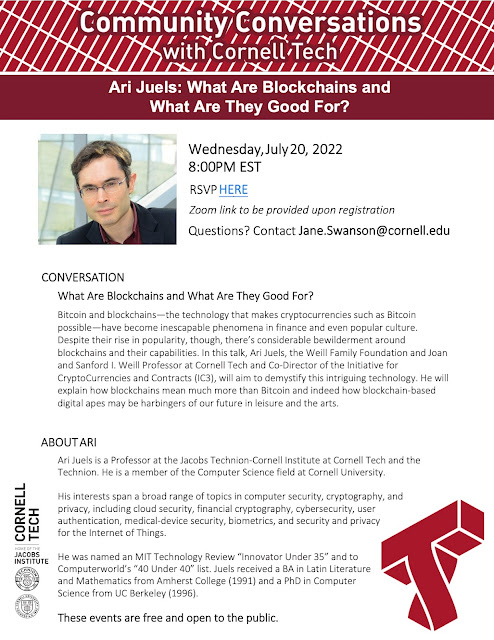
You are invited to the next Community Conversation with Cornell Tech: What are Blockchains and What Are They Good For? This event will be held on Wednesday, July 20th from 8:00 pm to 9:00 pm and should be very interesting – and illuminating! Register HERE
Bitcoin and blockchains—the technology that makes cryptocurrencies such as Bitcoin possible—have become inescapable phenomena in finance and even popular culture. Despite their rise in popularity, though, there’s considerable bewilderment around blockchains and their capabilities. In this talk, Ari Juels, the Weill Family Foundation and Joan and Sanford I. Weill Professor at Cornell Tech and Co-Director of the Initiative for CryptoCurrencies and Contracts (IC3), will aim to demystify this intriguing technology. He will explain how blockchains mean much more than Bitcoin and indeed how blockchain-based digital apes may be harbingers of our future in leisure and the arts.
Ari Juels is a Professor at the Jacobs Technion-Cornell Institute at Cornell Tech and the Technion. He is a member of the Computer Science field at Cornell University.
His interests span a broad range of topics in computer security, cryptography, and privacy, including cloud security, financial cryptography, cybersecurity, user authentication, medical-device security, biometrics, and security and privacy for the Internet of Things....
and testifying before Congress on the Blockchain in January 2022.
Click here to register for the Wednesday July 20 Virtual Conversation with Cornell Tech Professor Ari Juels to learn more about the Blockchain and what it is good for.
Watch these past Cornell Tech Faculty Roosevelt Island Community Conversations with:
Professor Serge Belongie on Computer Vision, Machine Learning and Augmented Reality. Watch the video here.
Professor Nicolai Dell on Creating Tech For Underserved Communities. Watch the video here.
Professor James Grimmelman on Law, Technology and the Sealand Data Haven. Watch the video here.
Professor Wendy Hu On Self Driving Cars and Human Interaction With Automation. Watch video here.
Digital Life Initiative on Social Media Political Manipulation of Elections and Ad Tracking. Watch video here.
Cornell Tech Assistant Director of Government and Community relations Jane Swanson reports:
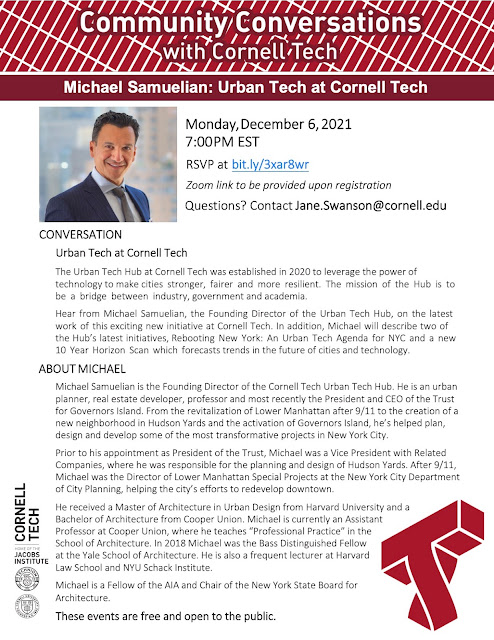
Please join us virtually for Community Conversations with Cornell Tech: Urban Tech. This event will be held on Monday, December 6th from 7:00 pm to 8:00 pm. Register HERE.
The Urban Tech Hub at Cornell Tech was established in 2020 to leverage the power of technology to make cities stronger, fairer and more resilient. The mission of the Hub is to be a bridge between industry, government and academia. You will hear from Michael Samuelian, the Founding Director of the Urban Tech Hub, on the latest work of this exciting new initiative at Cornell Tech. In addition, Michael will describe two of the Hub’s latest initiatives, Rebooting New York: An Urban Tech Agenda for NYC and a new 10 Year Horizon Scan which forecasts trends in the future of cities and technology.
Cornell Tech Assistant Director of Government and Community Affairs Jane
Swanson reports:
Just a reminder if you haven’t done so already to
register here for our next community event: Community Conversations with Cornell Tech
Faculty: The Importance of Being an Informed Consumer. This virtual event will
be held this coming Tuesday, April 20th at 4:30 pm EST. It promises to be a
fascinating and informative talk. See details below and please feel free to
forward this email to others who you feel would be interested in attending
this event. See you on Tuesday!
The
Roosevelt Island Community Conversation with Cornell Tech Faculty series continues tomorrow, September 22, but because of the Coronavirus Pandemic, the
conversation will be virtual, taking place on Zoom, instead of on the Cornell
Tech campus. According to Cornell Tech:
Tanzeem Choudhury: Can Precision Technology Shape the Future of Mental Health?
DATE: Tuesday, September 22nd, 2020
TIME: 6:30 pm to 7:30 pm EDT
RSVP: Register
at bit.ly/3c4Rsm5 Zoom link to be provided upon registration.
The Cornell TechConstruction & Community Task Force meets quarterly to keep the Roosevelt Island community informed and maintain an open dialogue with resident Task Force members of the community who are appointed by local elected officials - Congresswoman Maloney, State Senator Serrano, State Assembly Member Seawright, Manhattan Borough President Brewer, NYC Council Member Kallos and Community Board 8.
The Task Force is meeting tomorrow February 26 at the Bloomberg Academic Center from 6:00 PM to 7:30 PM and the public is invited to attend as well. Among items on the Agenda are:
Updates on Hotel & Verizon Executive Education Center construction and operations;
Community Engagement presentation;
Q&A;
All welcome; rsvp to Jane.Swanson@cornell.edu (not required but simplifies getting through security)
During the November 12, 2019 Task Force meeting, the new Cornell Tech Dean Greg Morrisett, who started in August 2019, introduced himself to the community. Dean Morrisett is a Roosevelt Island resident, living on campus with his wife Tania.
and whether Roosevelt Island could be a location for self driving car experimentation. Professor Ju replied:
Professor Ju also describes a recent visit by David Letterman and Melinda Gates to the Roosevelt Island Cornell Tech' campus
Today is the day! Season two of @Letterman's wonderful show is now available for streaming on @netflix. I hope you enjoy our conversation as much as I did—so excited to catch the rest of the interviews. #MyNextGuestpic.twitter.com/mBTsqbEzDS
Here's Professor Ju's full presentation to the Cornell Tech Faculty Roosevelt Island Community Conversation on human interaction with automation, self driving cars and her life here as a new Roosevelt Island resident with her family.
Part 1.
Part 2
Also a very interesting article on possible futures for self driving cars in NY State from City and State NY.
The Cornell Tech Faculty Roosevelt Island Community conversation begins a second year on Thursday October 10 with a presentation by Professor Wendy Ju on:
Where did this $^@#$! Autonomous Car Learn to Drive? Addressing Cross-cultural differences in Autonomous Car Design.
About this Event
Today’s autonomous cars are designed to follow the letter of the local law, but do not adapt to regional variations in driving behavior. At scale, this lack of adaptation can cause accidents and cost lives. Wendy Ju will talk about recent and on-going research to understand how cross-cultural differences should inform the design of autonomous cars.
About Wendy
Wendy Ju is an Assistant Professor at the Jacobs Technion-Cornell Institute at Cornell Tech and in the Information Science field at Cornell University. Her work in the areas of human-robot interaction and automated vehicle interfaces highlights the ways that interactive devices can communicate and engage people without interrupting or intruding. Dr. Ju has innovated numerous methods for early-stage prototyping of automated systems to understand how people will respond to systems before the systems are built. She has a PhD in Mechanical Engineering from Stanford, and a Master’s in Media Arts and Sciences from MIT.
... To date, Ju has carried out most of her experiments around Stanford. She has found that people there are pretty nonchalant when they encounter robots. “A lot of people are very pro-technology and they also work in technology so they’re very much like, ‘Oh yeah, this is happening now,’” she said.
Having recently moved to New York City, she is curious to find out whether people will behave differently or the same way. One of her first projects at Cornell Tech will explore how people interact with a troupe of chair robots -— essentially chairs that can reconfigure themselves in a space. She will also carry out further on-road experiments with ghost drivers....
The first 2018-19 Roosevelt Island Cornell Tech Faculty community conversation was with Professor Serge Belongie on Computer Vision, Machine Learning and Augmented Reality. Watch the video here.
The second 2018-19 Roosevelt Island Cornell Tech Faculty community conversation was with Professor Nicolai Dell on Creating Tech For Underserved Communities. Watch the video here.
Cornell Tech has initiated a series of Roosevelt Island Community Conversations between residents and Cornell Tech Faculty. The fourth conversation took place April 29 with Professor James Grimmelmann presentation on Law & Technology:
Does it seem like the Internet is out of control? Are technology companies undermining government control and freeing people to do absolutely anything they want online? And is that a good thing or a bad thing?
James Grimmelmann studies law and technology. He tries to understand today's digital controversies by looking for times when similar things have happened in the past. He will explain current struggles to regulate technology by telling the unbelievable real-life tale of HavenCo, one of the unlikeliest startups of all time. Its headquarters was an abandoned World War II anti-aircraft platform seven miles off the British coast — and the story just gets weirder from there. It includes pirate radio, machine guns, rampant copyright infringement, a Red Bull skateboarding special, perpetual motion machines, and the Montevideo Convention on the Rights and Duties of States.
James will use the story of HavenCo as a jumping-off point for a conversation about technology and democracy.
It was a fascinating presentation. Watch it below
followed by equally interesting questions from the audience.
The first Roosevelt Island Cornell Tech Faculty conversation was with Professor Serge
Belongie on Computer Vision, Machine Learning and Augmented Reality. Watch the video here.
The second Roosevelt Island Cornell Tech Faculty conversation was with Professor Nicolai Dell on Creating Tech For Underserved Communities. Watch the video here.
The third Roosevelt Island Cornell Tech Faculty conversation was with Professor Mor Naaman on Tech, Media & Democracy. Don't have video of that presentation.
Am looking forward to future Roosevelt Island Cornell Tech Faculty Community Conversations.
The Roosevelt Island Community Conversations with Cornell Tech faculty begun last fall, continues this eveing. On Monday, April 29, Professor James Grimmelman will speak on Law and Technology.
Community Conversations with Cornell Tech Faculty James Grimmelmann: Law and Technology
Does it seem like the Internet is out of control? Are technology companies undermining government control and freeing people to do absolutely anything they want online? And is that a good thing or a bad thing?
James Grimmelmann studies law and technology. He tries to understand today's digital controversies by looking for times when similar things have happened in the past. He will explain current struggles to regulate technology by telling the unbelievable real-life tale of HavenCo, one of the unlikeliest startups of all time. Its headquarters was an abandoned World War II anti-aircraft platform seven miles off the British coast — and the story just gets weirder from there. It includes pirate radio, machine guns, rampant copyright infringement, a Red Bull skateboarding special, perpetual motion machines, and the Montevideo Convention on the Rights and Duties of States.
James will use the story of HavenCo as a jumping-off point for a conversation about technology and democracy.
About JAMES
James Grimmelmann is a Professor at Cornell Tech and in the Law School at Cornell University. James writes about search engines, social networks, data havens, hackers, trolls, copyright-infringing robots, and magical 3D printers, among other things. He is the author of the casebook Internet Law: Cases and Problems, now in its eighth edition, and of over fifty scholarly articles and essays.
Click here to register for the Roosevelt Island Cornell Tech Community Conversation with Professor James Grimmelmann.
The first Roosevelt Island Cornell Tech Faculty conversation was with Professor Serge
Belongie on Computer Vision, Machine Learning and Augmented Reality. Watch the video here.
The second Roosevelt Island Cornell Tech Faculty conversation was with Professor Nicolai Dell on Creating Tech For Underserved Communities. Watch the video here.
The third Roosevelt Island Cornell Tech Faculty conversation was with Professor Mor Naaman on Tech, Media & Democracy. Don't have video of that presentation.
The Roosevelt Island Community Conversations with Cornell Tech faculty begun last fall, continues next week. On Monday, April 29, Professor James Grimmelman will speak on Law and Technology.
Monday, April 29, 2019 from 6:30 PM to 7:30 PM (EDT)
Does it seem like the Internet is out of control? Are technology companies undermining government control and freeing people to do absolutely anything they want online? And is that a good thing or a bad thing?
James Grimmelmann studies law and technology. He tries to understand today's digital controversies by looking for times when similar things have happened in the past. He will explain current struggles to regulate technology by telling the unbelievable real-life tale of HavenCo, one of the unlikeliest startups of all time. Its headquarters was an abandoned World War II anti-aircraft platform seven miles off the British coast — and the story just gets weirder from there. It includes pirate radio, machine guns, rampant copyright infringement, a Red Bull skateboarding special, perpetual motion machines, and the Montevideo Convention on the Rights and Duties of States.
James will use the story of HavenCo as a jumping-off point for a conversation about technology and democracy.
ABOUT JAMES
James Grimmelmann is a Professor at Cornell Tech and in the Law School at Cornell University. James writes about search engines, social networks, data havens, hackers, trolls, copyright-infringing robots, and magical 3D printers, among other things. He is the author of the casebook Internet Law: Cases and Problems, now in its eighth edition, and of over fifty scholarly articles and essays.
Click here to register for the Roosevelt Island Cornell Tech Community Conversation with Professor James Grimmelmann.
The first Roosevelt Island Cornell Tech Faculty conversation was with Professor Serge
Belongie on Computer Vision, Machine Learning and Augmented Reality. Watch the video here.
The second Roosevelt Island Cornell Tech Faculty conversation was with Professor Nicolai Dell on Creating Tech For Underserved Communities. Watch the video here.
The third Roosevelt Island Cornell Tech Faculty conversation was with Professor Mor Naaman on Tech, Media & Democracy. Don't have video of that presentation.
Niti Parikh, Creative Lead of the MakerLAB at Cornell Tech, will present her work as a designer, maker, and educator. She will present on how we can empower learners of all ages and backgrounds to express their ideas and build new relationships through making. Examples include teaching ‘3D Printed Life Hacks” with senior citizens, medical school students and engineering / design students, exploring low-tech fabrication through the ‘Maker’s Corner’ with kids ages 5-13 at public schools in CA and NY and ‘npstudio’ where we practice modern day crafts to solve design problems big and small.
The 3rd in a 4 Part series of Roosevelt Island community conversations with Cornell Tech Faculty members takes place Wednesday, December 6 with Professor Mor Naaman.
Mor's lab designs, builds, and studies social systems, with a focus on technology, media and democracy - issues that have never been more relevant to our society than they are today. Mor will break it all down for us in what promises to be an enlightening and thought-provoking presentation.
Date and Time
Thu, December 6, 2018, 6:30 PM – 7:30 PM EST
Location
Tata Innovation Center, 11 East Loop Road, New York, NY 10044
Mor Naaman is an associate professor of Information Science at the Jacobs Technion- Cornell Institute at Cornell Tech. He is the founder of the Connective Media hub, co-directs the Oath- supported Connected Experiences Lab, and leads the Social Technologies research group.
Associate Professor @informor's innovative course "Tech, Media & Democracy" is a collaboration between six universities in New York City. https://t.co/I6REfh8DVf
Click here to register for the Thursday, December 6, Roosevelt Island Cornell Tech Faculty Community Conversation with Professor Mor Naaman.
The first Roosevelt Island Cornell Tech Faculty conversation was with Professor Serge
Belongie on Computer Vision, Machine Learning and Augmented Reality. Watch the video here.
The second Roosevelt Island Cornell Tech Faculty conversation was with Professor Nicolai Dell on Creating Tech For Underserved Communities. Watch the video here.
I do research at the intersection of human-computer interaction (HCI) and information and communication technologies for development (ICTD). My high-level goal is to create new technologies that empower underserved populations to overcome global challenges in critical domains like healthcare, security and privacy, accessibility, and more....
Here's the October 17 Roosevelt Island Cornell Tech Community Conversation with Professor Nicola Dell. (Click full screen icon at bottom right of videos for better view)
Part 1 - Cornell Tech Assistant Director of Government and Community Affairs Jane Swanson introduces Professor Dell.
Part 2 - Professor Dell describes her work creating technologies for underserved communities on a global and local basis including here in NYC. Projects discussed are:
The first Roosevelt Island Cornell Tech Faculty conversation was with Professor Serge
Belongie on Computer Vision, Machine Learning and Augmented Reality. Watch the video here.
The Cornell Tech Community Conversations are very interesting. Try to attend. You'll find it fascinating.
Cornell Tech has initiated a series of Roosevelt Island Community Conversations between residents and Cornell Tech Faculty. The first conversation took place September 25 with Professor Serge Belongie.
Here's the September 25 Roosevelt Island Cornell Tech Community Conversation with Professor Serge Belongie. (Click full screen icon at bottom right of videos for better view)
Part 1 - Cornell Tech Assistant Director of Government and Community Affairs Jane Swanson introduces Professor Belongie.
Part 2 & 3 - Professor Belongie explains what brought him to Cornell Tech and Roosevelt Island and describes his Computer Vision research using as an example identifying birds
Part 5 & 6 - Question and answers from residents including deep learning methods identifying music, video, disease as well as future of self driving vehicles (Professor Belongie is very skeptical of self driving cars and would not want to get in one).
On October 17, the second Cornell Tech Faculty Roosevelt Island Community Conversation took place with Professor Nicola Dell. Will post video of Professor's Dell's presentation soon.
The final two Cornell Tech Faculty Roosevelt Island Community Conversations are:
Nov. 29th: Prof. Mor Naaman
Dec. 11th: Prof. James Grimmelmann
The Cornell Tech Community Conversations are very interesting. Try to attend.
The second in a 4 Part series of Roosevelt Island community conversations with Cornell Tech Faculty members takes place Wednesday, October 17 with Professor Nicola Dell.
Professor Dell will talk about her work designing and building technologies for under-served communities, both in the US and around the world. She will also take questions from the audience.
Community Conversations with Cornell Tech Faculty
MEET: NICOLA DELL
Professor at Cornell Tech & The Cornell Information Science Department
Wednesday, October 17 @ 6:30 - 7:30 PM
Tata Innovation Center
Cornell Tech, 11 East Loop Road
To Register use link: https://bit.ly/nicoladell
or email: Jane.Swanson@cornell.edu or call 646-971-3744
BACKGROUND
Nicola Dell is an Assistant Professor at the Jacobs Technion-Cornell Institute at Cornell Tech and a member of Cornell's Information Science Department. Professor Dell was born in Zimbabwe and received a B.Sc. in Computer Science from the University of East Anglia (UK) in 2004, and an M.S. and Ph.D. in Computer Science and Engineering from the University of Washington in 2011 and 2015 respectively..
RESEARCH INTERESTS
Professor Dell’s research interests are in human-computer interaction (HCI) and information and communication technologies for development (ICTD). Her main focus is on designing, building, and evaluating novel computing systems that improve the lives of underserved populations in the US and around the world. Professor Dell is broadly interested in understanding the social, technical, and infrastructural challenges faced by diverse populations and creating new technologies to address their uniquely-situated needs. To do this, she partners with numerous NGOs and government ministries to design and deploy novel computing systems that aim to have a positive impact in the world.
COMING UP
• Nov. 27th: Prof. Mor Naaman
• Dec. 11th: Prof. James Grimmelmann
Cornell Tech Assistant Director of Community & Government Relations Jane Swanson described the upcoming series of community conversation with Cornell Tech Faculty and Roosevelt Island residents.
Roosevelt Island is a mixed income, racially diverse waterfront community situated in the East River of New York City between Manhattan and Queens and is jurisdictionally part of Manhattan. The Roosevelt Island Tramway, which connects Roosevelt Island to the rest of Manhattan, has become the iconic symbol of Roosevelt Island to its residents.
The Purpose of this Blog is to provide accurate and timely information about Roosevelt Island as well as a forum for residents to express opinions and engage in a dialogue to improve our community.